Japan has been a depressed economy for some time. Since the market collapse in 1989 to 2004 the Japanese economy has been in a deflationary spiral. Interest rates were at very low levels to keep the yen low to encourage exports, but the banks were not lending money. Neither were they liquidating their loan portfolios until the 2000s. They were waiting for the property market to absorb their bad loan portfolios. With negative population growth, they had to wait a long time. They are still liquidating, though with a strong global economy helping local exports and job growth, investment in property increased in the early 2000s, but it wasn't until 2004 that deflation ebbed. The rise in property prices started in Tokyo, and other small growth cities like Nagoya, Fukuoka.
The Japanese nation has been very slow to open up the economy to the outside world. This problem is politics. In many respects the business world is alot more progressive. There has been a shift to temp workers, the seniority, lifetime employment system is well on its way to the museums. There is a raft of discount stores undercutting the traditional department stores. Change is not evenly spread. Even government is taking some steps to reform, though policy initiatives have been slow coming. Most of the initiatives have been cost cutting.
The positive news is that whilst Japanese population growth is negative, there is still internal population movement to the cities, and not just the principal cities like Tokyo, Osaka, Fukuoka, Nagoya, Hiroshima, Nagasaki. Regional centresw like Sendai, Morioka, Nagano have also been attracting more population.
In the cities foreclosed property is well bid by professional investors. In the rural areas such property investment is dominated by real estate agents and local astute investors willing to take risks that most locals shy away from. Actually the risks are really quite mild since foreclosed property is often heavily discounted.
First issue is - You really need to know what you want. Is the property for lifestyle (a love shack close to Tokyo), investment return, an owner-occupied residence near work, or a business residence. Any love shack really needs to be within 1hr of Tokyo, preferably younger than 12yo, and close to a station. If you dont spend muchtime in Japan, go for a small inner city apartment. They can be rented to students, or just a place to store your stuff. Apartments generally make less sense for investment. The gross yield is good, but they carry high compulsory management fees. These fees cover restoration work, but the use of funds is not efficient. The trick is to find properties that homeowners generally dont want, as they will not be bidding, and hopefully nor will the real estate agents who respresent them, who just want to flip these properties. As indicated, properties in the cities are well-bid, so best to look in countryside. I go for attract rural areas clsoe to Tokyo. I am betting on a lifestyle proiorities change - so I like the west Tokyo area. Ome is nice, but more expensive than neighbouring Hanno. My ex-GF and I also bought a place in the NW of Saitama, close to shopping by car, though 5km from the station. Agents did not bid because most buyers want close to station and more land. This was a nice house just on 80m2 of land. It made a great rental in a quiet, scenic valley.
You want to bid on properties that are older than 12yo, and need a little work, in the hope of getting agents out. Also if you can adopt some lateral thinking, you might find a property you can use. eg. A warehouse outside Tokyo as a distribution centre for imports, or a dormitory, useful for teaching kids English. I bought one next to a private school. You can buy these properties very cheap because they require too much renovation to convert into a home.
Old homes in Japan, say over 20yo are essentially valued at less than Y0.5mil, yet they have a useful life of another 20 years without much maintenance. My place at Hanno had a pile of timber all around it that discouraged buyers. It was 18yo, so the outside stairs needed painting, the downpipes are disintegrating, the plumbing is corroding.
My big lesson has been to buy in residential subdivisions, unless you are able to get information on plumbing from neighbours. I assumed my dormitory in west Tokyo had plumbing because it was a free-standing building, but it was connected to the neighbours site. The power was also connected through him. The good news is that there is a 70% subsidy to get septic connected in my area if I am a resident. I am not. I stay at my place just 1-2 months a year in Spring-Summer.
I like the regional cities as well. There are developers selling new designer homes to Australians in Hokkaido for skiing. Why not look for a foreclosed property outside these exclusive neighbourhoods for 10% of the price. Sure it wil be a little older, Japanese style, and not as close to facilities, buit its a significant saving, particularly if you are owner-user. Such off-the-plan places are targeted at executives with more money than time. There is the tax-incentive as well. Having your name in katakana makes tax sense I'm sure.

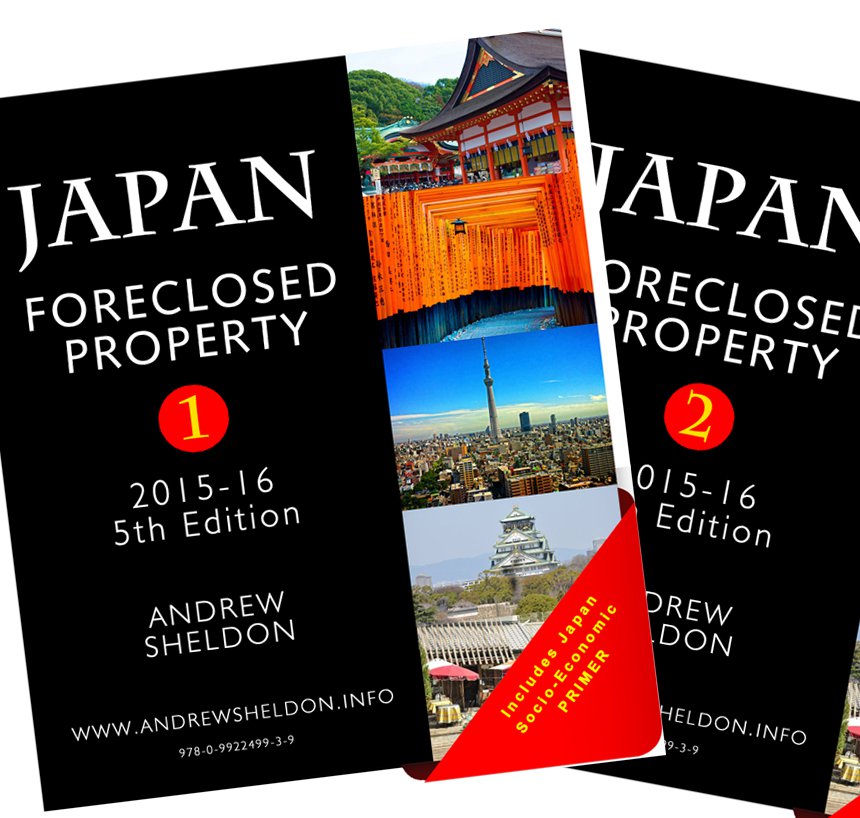
 This report is finally available. In preparing the report it became apparent to me that:


