Are you aware that you can buy a house & lot in Japan for as little as $10,000. Surprising but true! Japan is a large market, with a plethora of cheap properties up for auction by the courts. Few other Western nations offer such cheap property so close to major infrastructure. Japan is unique in this respect, and it offers such a different life experience, which also makes it special. Some property is in rural areas subject to depopulation, but there are plenty of properties in the cities too. I bought a dormitory 1hr from Tokyo for just $US30,000.
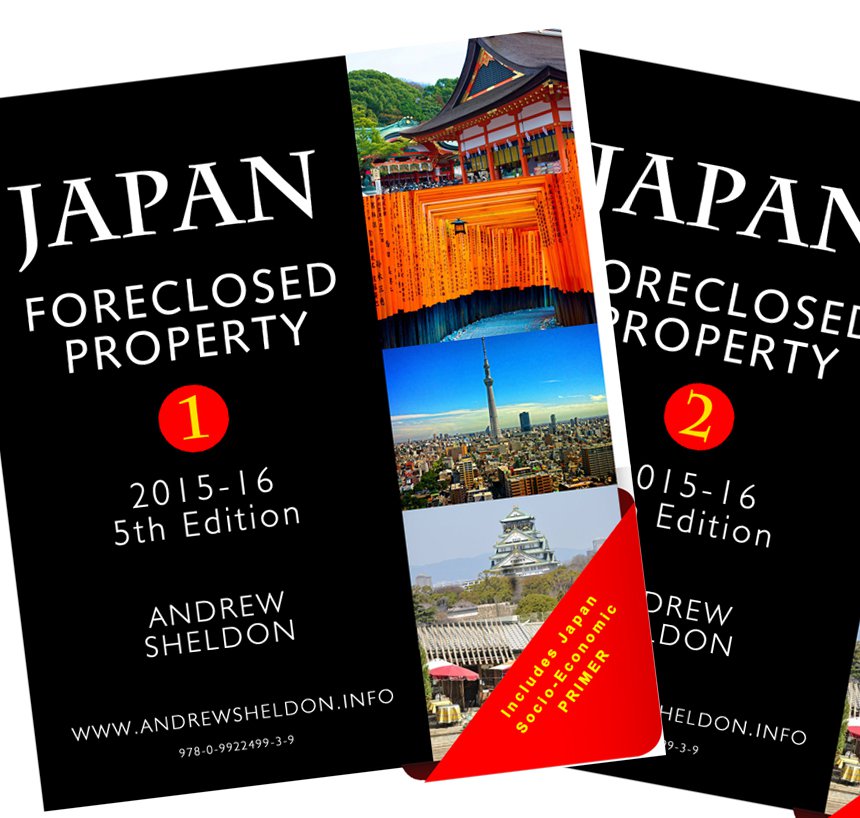
You can view foreclosed properties listed for as little as $US10,000 in Japan thanks to depopulation and a culture that is geared towards working for the state. I bought foreclosed properties in Japan and now I reveal all in our expanded 200-page report. The information you need to know, strategies to apply, where to get help, and the tools to use. We even help you avoid the tsunami and nuclear risks since I was a geologist/mining finance analyst in a past life. Check out the "feedback" in our blog for stories of success by customers of our previous reports.
Japan Foreclosed Property 2011 - 2012 eBook - $19.95Download a copy of the table of contents.
CompanyThe latest population statistics for Japanese cities shows that the fastest growing cities are:
1. Kawasaki City 1.4%/year
2. Saitama City 0.8%/year
3. Fukuoka City 0.75%/year
These growth rates don't look so impressive, but you need to consider that internal migration in each city adds an extra dynamic resulting in faster growth in some areas, and lower growth in others. For this reason these city-wide statistics are of little benefit if you are seeking to buy property. For instance Tokyo-23 grew at 0.65%, however migration from some areas of Tokyo to others will polarise the average figures.
For this reason we look at the statistics for each village, town and city within the Tokyo and Saitama prefectures. Of course similar analysis can be performed on other prefectures too. If you are interested in population statistics for Saitama or Tokyo, refer to our Population Charts for Tokyo and Saitama precincts. It will give you clues on where to buy property.
------------------------------------------------------------------------------------- Andrew Sheldon www.sheldonthinks.com
The cheapest condo in the Philippines is likely to be some failed apartment complex which is half-complete. I found one exactly like that in a prime position on the freeway into Manila from the South. It had turned into a ghetto. Its an amazing thing about the Philippines is that people can have the dodgiest of homes, but they will have the latest car - a Honda Civic or something, rather than the 10 year old Japanese corolla import they can really afford. Financial literacy is not a local skill - at least not the lesson I learned about money. They of course learned that if you want to get somewhere then you need to present to impress; as that is the way you climb the social ladder. Personally, they are not the type of people I would like to live next door to because they would see me as the next rung on the ladder. The best condos I found in the Philippines that I came across were those built by DMCI. This is an engineering company, and it shows in the quality of their workmanship. You can tell the company is run by an engineer however because we found their customer service to be shocking. They did however repay our deposit...though they took a long time. We particularly liked the design of Riverfront Estates and Raya Gardens in the south of the city. They might not be the best location but they are pretty good, and they are very cheap. You will pay just P2.3-2.5 million for these 2 bedroom condos, though prices have likely increased since I last looked. ------------------------------------ Andrew Sheldon www.sheldonthinks.com
The cheapest property in Tokyo is going to be a certain type of property, with certain types of characteristics, so its important to be weary. Risk is managed, not avoided. The difference between the people taking action and those who don't is information. My ex-GF was a licensed real estate agent in Japan, so we developed a strategy for buying property, and bought two properties together and looked at many others, and bid on 4 in total. Our focus was Tokyo, but we also looked at Shizuoka closely, and other areas like the ski areas.
So where might you expect to find the cheapest property in Japan. Well its likely to display the following characteristics: 1. A very old house that no one wants to live in - say over 50 years old 2. A very small land lot, maybe oddly shaped 3. A house with actually no land title - a leasehold - so you will end up paying rent - and face the possibility of eviction 4. Remote from transport, services, infrastructure 5. No road access - hard to believe its possible 6. Damaged property in some sense - so cheaper to demolish and start afresh 7. A property perched on the side of a slope with engineering/safety issues
This is the bottom of the market, and there are plenty of properties around like this that no one will touch. In fact its probable that you will not like them either, but they are there, and that is where the bottom is, so from that basis you can start looking up. So what will you pay for such a place? Well I don't know but I'm guessing a few thousand dollars only because its such a bad proposition. I have seen a property in Shizuoka at the end of a railway line, 2km from town, old 40yo house, crowded in among other houses, but otherwise a very scenic area, and in an area prized for its onsens. This property was offered for Y800,000 when I looked (say $US9,000). It was remote from a large city - say 4 hours from Tokyo - 2 hours fast, 2 hours slow train. I would pay $60,000 to get 6 hours from Sydney for the same thing. Way way outback! ----------------------------------------------- Andrew Sheldon www.sheldonthinks.com
House and lots are generally not cheap in the Philippines because such property is generally provided with services connected, which are expensive. I say generally because there are exceptions - and they are often failed estates which were not property approved by the government regulator. We looked at one such estate and you could buy the land for just P200/m2. Some of the properties already had houses on them. We saw a very nice looking house for P1 million. This estate was close to a large city (300,000 people) and a lake. The problem was the estate was abandoned, so there was no maintenance, security or telephone services. Everything else was however already developed - including a function room, swimming pools and sealed roads.
More commonly you can buy land in subdivisions for as little as P2000/m2, with more exclusive subdivisions in rural areas over P5000/m2, and over P10,000/m2 as you approach the cities. There are some very attractive estates around with fabulous golf courses, club houses. The problem with some of these estates is that they lack any atmosphere. They may as well be abandoned because none of the property owners live there. In fact people are buying these properties and sitting on the vacant land for decades until they retire. They make the worst type of investment. House and lots or developing a lot does make sense if you are a foreigner or wealthy Filipino looking to protect yourself or your possessions. Anything not tied down gets stolen so security is an issue. That is why people move to the gated subdivisions. They are not all the same, so I would recommend our report. ------------------------------------------------- Andrew Sheldon www.sheldonthinks.com
The cheapest property in the Philippines is unsurprisingly unimproved property in rural areas. Its usually land not subject to pasture improvement isolated from the major commercial areas, and often there is no road access. It might even be perched on the side of a hill side or a volcano. We looked at a block of land with great views over Lake Taal. The property was perched on the edge of he crater - world class views if the slope holds up in the next volcanic eruption. :) You could purchase it for P20/m2. There was other land for P10/m2 which was inside the crater, 500m down a steep set of stairs, and sloping at 70-95%. Yes, I believe the land was overturned in parts. Would you want to live there? I don't think so, but I though you might want to know just how cheap property can get. In fact you will find cheaper, say in places like Quezon. Areas which are either not cleared or remote. Agricultural land is far cheaper usually than commercial or residential land because it does not have services or connections. But you need to know about the rules governing such land. What is a report for but to convey such information. ----------------------------------------------- Andrew Sheldon www.sheldonthinks.com